The Cube Orange autopilot is the newest and most powerful model in the CubePilot ecosystem, designed primarily for manufacturers of commercial systems.
What is CubePilot?
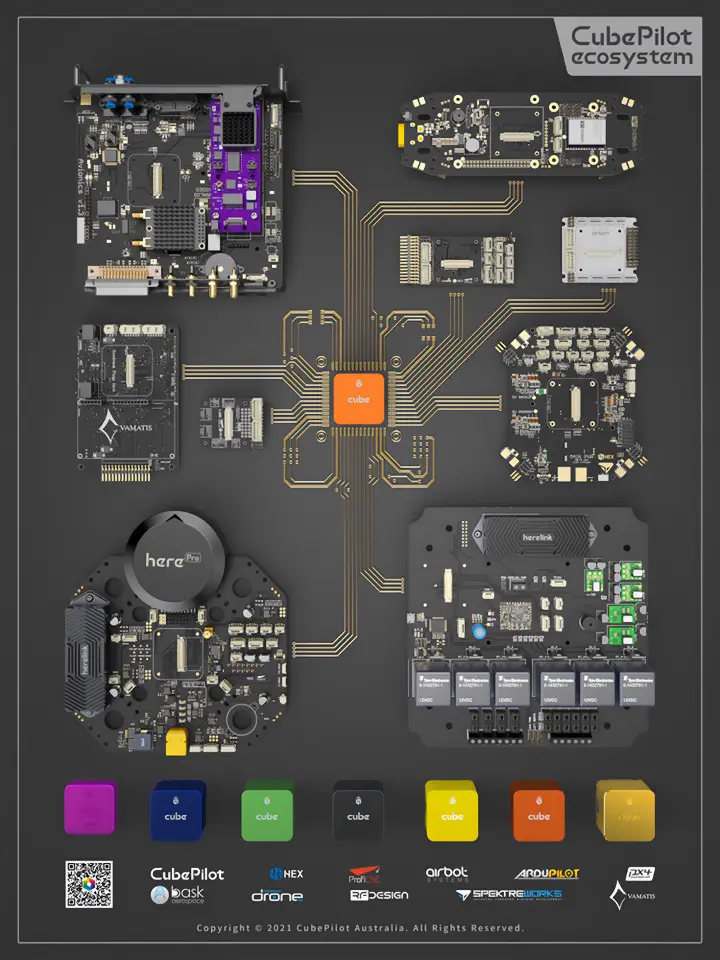
CubePilot is a project that aims to provide a hardware and software ecosystem for the constantly growing unmanned systems industry. CubePilot lets you tailor the system to a specific application, getting the best out of state-of-the-art technology. With an open-source structure and the community at its heart, and reliability and quality as its character, CubePilot keeps bringing high-quality hardware to the market. The CubePilot ecosystem currently consists of the Cube Autopilot series, which serves as the core of the system, with a wide range of accessories and carrier boards developed with great support from the community and industry.
The autopilot is designed to be used with a carrier board built specifically for a given application to reduce wiring, improve reliability and make assembly easier.
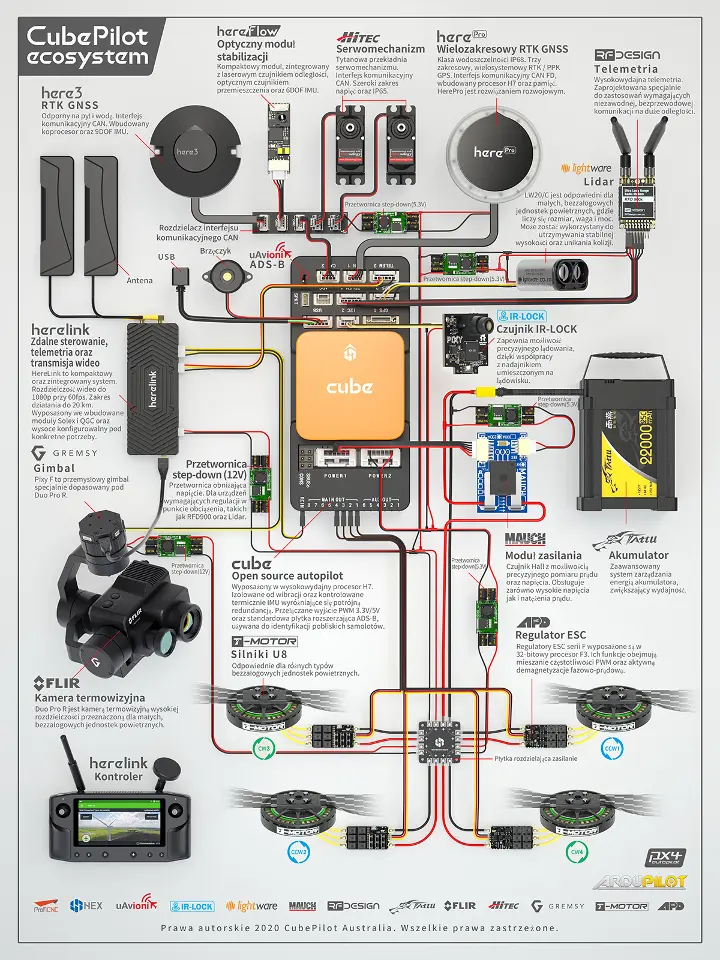 CubePilot ecosystem. Source: www.ardupilot.org
Features of the Cube Orange system
The autopilot is designed for hobby users, commercial system integrators and UAS manufacturers. The Cube Orange is part of a broad ecosystem of autopilot modules and carrier boards. All Cube models are compatible with all carrier boards, allowing users to choose the carrier board that best suits their needs.
The Cube Orange is available as a standalone module or as a package The Cube Orange+ Standard Set with a new, updated version of the original carrier board that includes an integrated ADS-B In receiver from uAvionix. Both options are available in our shop.
Our latest content
Check out what's new in our company !
The Cube Orange specifications
Fully compatible with all CubePilot carrier boards; all inputs and outputs go through an 80-pin DF17 connector, which allows a plug-and-play solution for commercial system manufacturers. Manufacturers can design their own carrier boards to suit the specific needs of their unmanned systems.
- Faster H7 SoC processor with 1 MB RAM
- Improved triple-redundant IMU sensors
- The IMU is temperature-controlled by built-in heating resistors, allowing an optimal IMU operating temperature
- The entire flight management unit (FMU) and inertial measurement unit (IMU) are housed in a relatively small enclosure (the cube). (https://ardupilot.org)
- The Cube has vibration isolation on two IMUs, with a third fixed IMU as a reference / backup. (https://docs.px4.io/)
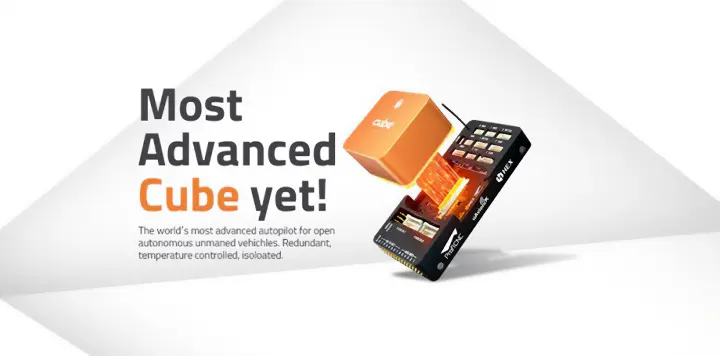 Cube Orange flight controller. Source: www.docs.px4.io
ADS-B carrier board
The new ADS-B carrier board is identical to the standard version; the main changes compared with the original carrier board are:
- Integration with the uAvionix ADS-B IN receiver
- Built-in ADS-B antenna
- Intel Edison bay and debug USB ports removed
PWM outputs
The Cube has eight PWM outputs connected to the IO controller, which can be controlled by the IO controller directly via the R/C input even when the FMU is not active (failsafe / manual mode). Supported PWM signal rates go up to 400 Hz.
All PWM outputs are ESD-protected and designed to survive accidental mis-wiring of servos without damage. The servo drivers are rated for a 50 pF servo input load over 2 m of 26 AWG cable.
Carrier board
The original carrier board has separate connectors for each peripheral port (with a few exceptions).
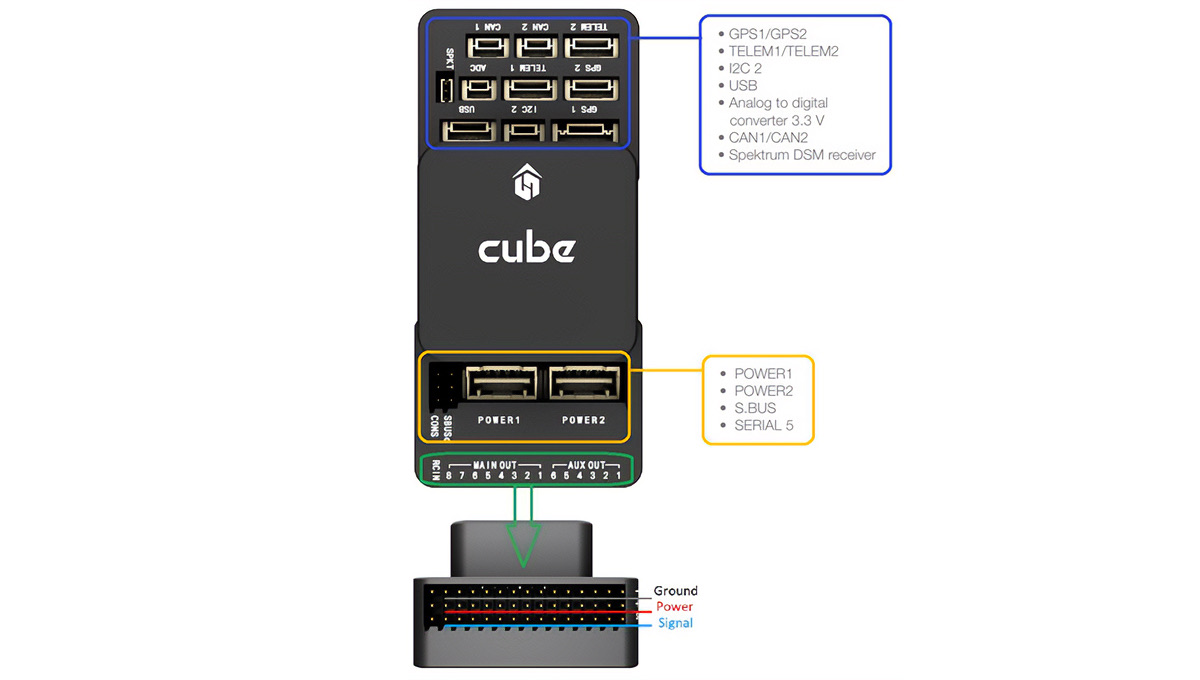 Top side (GPS, TELEM etc.). Source: https://docs.px4.io
Power architecture
The Cube provides power routing, over- and under-voltage detection and protection, filtering, switching, current limiting and transient suppression for peripherals. The peripheral power outputs have ESD and EMI filters. Power to peripherals is disconnected when the available supply voltage drops below 2.7 V or rises above 5.7 V.
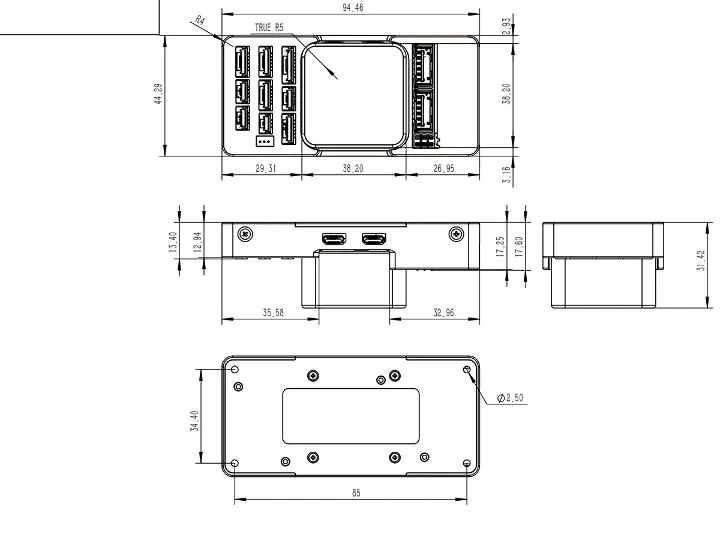 The Cube Orange Standard Set. Source: www.worldronemarket.com
Other power features:
- Single, independent 5 V supply for the flight controller and peripherals.
- Integration with two power bricks or a compatible alternative, including current and voltage sensing.
- Low power consumption and heat dissipation.
- Power distribution and monitoring for peripherals.
- Protection against common wiring faults; under/over-voltage, over-current and thermal protection.
- Brown-out resilience and detection.
Backup power
The Cube has a backup power port; it is configured in the same way as the main power input. At input voltages above 5.7 V the supply is blocked. The Cube and peripherals can draw up to 2.75 A when running on backup power, provided the other power source can supply the required current.
USB power
Supported for firmware updates, testing and development. USB power is supplied to the peripheral ports for testing, but total current draw must typically be limited to 500 mA, including peripherals, to avoid overloading the host USB port.
Backup capacitors
Both the FMU and IO microcontrollers have capacitor-backed real-time clocks and SRAM. The on-board backup capacitor has enough capacity for the intended use of the clock and SRAM, which is to store data so that control can be recovered after an unintended loss of power or other in-flight restart. The capacitors are charged from the FMU 3.3 V rail. This only works if the firmware supports this feature.
Voltage, current and fault sensing
Excessive current on the peripheral power ports can be detected by the FMU. A hardware lockout prevents damage caused by a persistent short circuit on these ports. The lockout can be reset by the FMU software.
EMI filtering is provided at key points in the system using high-insertion-loss feed-through filters. These filters are combined with TVS diodes on the peripheral connectors to suppress power supply transients.
Reverse polarity protection is provided on each power input. USB signals are filtered and terminated with a combined terminator/TVS array.
Most digital peripheral signals (all PWM outputs, serial ports, I2C port) are driven by ESD-hardened buffers and have series blocking resistors to reduce the risk of damage from accidental connections. (https://docs.cubepilot.org)
 CubePilot. Source: www.unmannedtechshop.co.uk
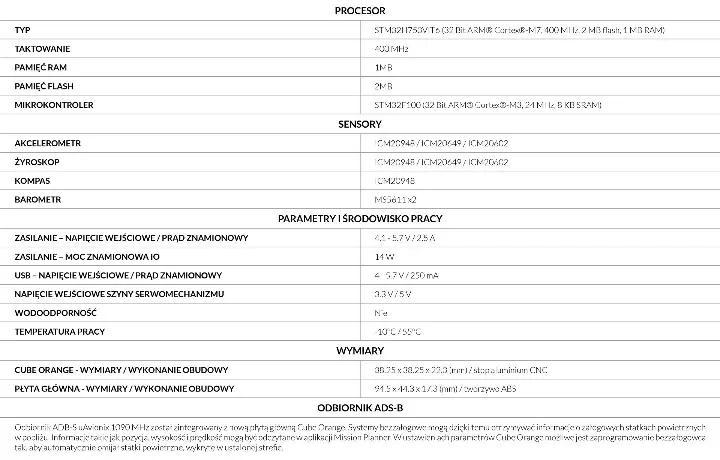
Technical specifications
 Source: www.drony.net
Comparison of The Cube models
When comparing the Cube Orange with its predecessors, note that The Cube Black is the base version. The Cube flight controllers share the same housing but differ inside. The only module that is smaller is The Cube Purple, because it has no isolated IMU. All The Cube models are equally compatible with the same carrier boards.
The Cube Orange is an improved version of the base Cube Black and is currently the most powerful model of them all, able to provide many more autopilot features in the future.
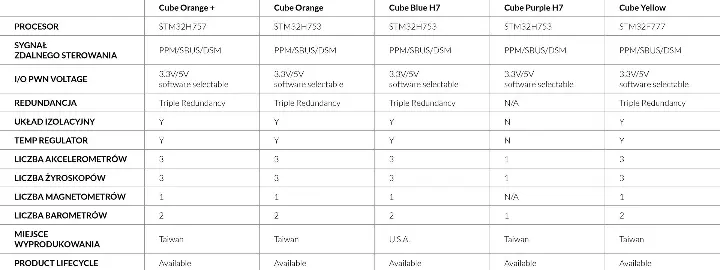
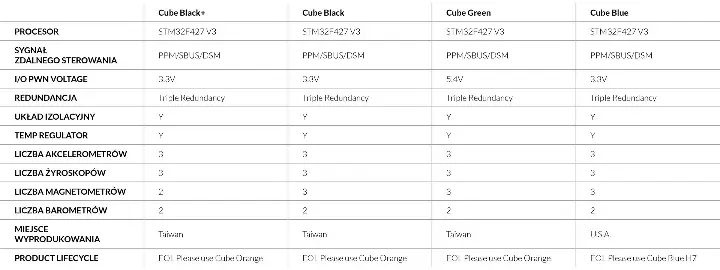 The Cube models comparison table. Source: https://docs.cubepilot.org/user-guides/autopilot/the-cube-module-overview
The Cube products available in our shop
Our latest content
Check out what's new in our company !
Bibliography
https://docs.cubepilot.org/user-guides/autopilot/the-cube-module-overview#pwm-outputs [Accessed: 29.08.2022]
https://www.mybotshop.de/Pixhawk-Orange-Cube-Standard-Set_1 [Accessed: 29.08.2022]
https://docs.px4.io/main/en/flight_controller/cubepilot_cube_orange.html [Accessed: 29.08.2022]
https://docs.cubepilot.org/user-guides/ [Accessed: 29.08.2022]
https://docs.cubepilot.org/user-guides/autopilot/the-cube-module-overview [Accessed: 29.08.2022]
https://ardupilot.org/copter/docs/common-thecubeorange-overview.html [Accessed: 29.08.2022]