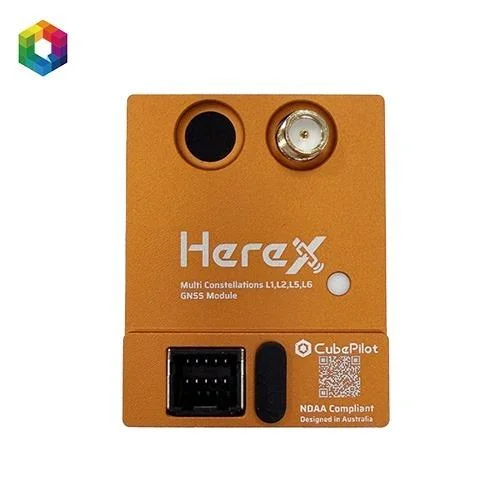
HereX All Band Single Antenna GNSS
HereX All Band Single Antenna GNSS
All-band RTK positioning. Bring your own antenna.
HereX is a compact all-band high-precision GNSS receiver. It tracks GPS, Galileo, BeiDou, QZSS and NavIC across the L1, L2, L5 and L6 bands. It reaches centimetre-level accuracy with RTK corrections, and with a PPP-RTK correction service it gets close without a base station of your own. Navigation updates run at up to 25 Hz. HereX has no antenna on board: connect any active all-band antenna to its SMA port and mount it wherever the sky view is best. HereX powers the antenna and supervises it. Two serial ports, USB-C and a single locking connector let HereX fit autopilots, survey rigs, base stations and embedded systems alike.
Every band, every major constellation
HereX receives signals across all four GNSS bands: GPS L1C/A, L2C and L5; Galileo E1, E5a and E6; BeiDou B1I, B1C, B2a and B3I; QZSS L1C/A, L1C/B, L2C and L5; and NavIC L5. More signals per satellite means faster ambiguity resolution, better rejection of multipath, and a fix that holds near structures, under foliage and in urban canyons. SBAS (WAAS, EGNOS, MSAS, GAGAN) is supported for metre-level corrections without a base station.
Centimetres in seconds
- RTK with RTCM 3.4 corrections from your own base or a network: 0.6 cm + 1 ppm horizontal (CEP), with convergence in under 7 seconds.
- PPP-RTK with SPARTN corrections: under 6 cm horizontal, with convergence in under 40 seconds and no local base station.
- Up to 25 Hz navigation updates in RTK, for fast vehicles and tight control loops.
- Base station mode: HereX can output RTCM 3.4 corrections itself, so the same unit works as a rover or as a base.
Your antenna, where you need it
The antenna connects through a standard SMA port, so you choose it to suit the job: a survey-grade antenna on a base station, a helical antenna on an airframe, or a roof-mounted antenna on a vehicle. HereX feeds the active antenna and monitors it. It detects a missing or shorted antenna, reports it, and protects the supply.
Ready the moment it powers up
A rechargeable backup cell keeps the satellite data and time while power is off, so HereX starts hot and gets a fix in seconds. Status LEDs show power and RTK state at a glance.
Built to resist interference and spoofing
- Jamming and RF interference detection, with a built-in spectrum view of the RF environment.
- Spoofing detection, and Galileo OSNMA navigation-message authentication.
- Secure boot (signed firmware only) and configuration lockdown.
Timing and raw data
- A timing pulse with 20 ns RMS accuracy, plus an event input to time-stamp camera triggers or survey marks.
- Raw carrier-phase and pseudorange output on every tracked signal, for post-processing (PPK) and research.
Connects to anything
- A 10-pin locking connector carries 5 V, two serial ports, the timing pulse, the event input and LED lines.
- USB-C provides power, configuration and data straight from a laptop.
- HereX works with ArduPilot and PX4 autopilots, and with any system that reads standard NMEA, UBX or RTCM.
Key specifications
- Receiver: All-band high-precision GNSS, concurrent multi-constellation
- Bands: L1, L2, L5, L6
- Constellations: GPS, Galileo, BeiDou, QZSS, NavIC; SBAS
- RTK accuracy (horizontal, CEP): 0.6 cm + 1 ppm
- PPP-RTK accuracy (horizontal, CEP): < 6 cm
- Convergence: RTK < 7 s; PPP-RTK < 40 s
- Navigation update rate: Up to 25 Hz
- Time to first fix: Cold 25 s; hot 2 s
- Timing pulse: 20 ns RMS
- Corrections: RTCM 3.4 (in and out), SPARTN 2.0.2
- Security: Anti-jamming, anti-spoofing, Galileo OSNMA, secure boot
- Antenna: External active antenna via SMA; powered, with open and short detection
- Interfaces: 10-pin locking connector (2 × serial, PPS, event input, LED, 5 V), USB-C
- Backup: Rechargeable cell for hot starts
- Power: 5 V (connector or USB-C)