The world's forests cover about 3,999,134 thousand hectares (around 4 billion ha), and average forest cover is about 30.6% of the Earth's land area. The largest forest areas are in countries such as Russia, Brazil and Canada, which account for 20%, 12% and 9% of the world's forests respectively. In Poland, forests cover almost 30% of the land area.
Especially today, as our environmental awareness grows, we are beginning to see how important trees are for the Earth's ecosystem, and with them state-owned and private forests. They give us access to clean air by absorbing carbon dioxide from the atmosphere, and they are also an essential raw material. Unfortunately, forests are exposed to many harmful factors, which is why conscious forest management – and with it regular monitoring of green areas – is becoming so important.
What problems do foresters face?
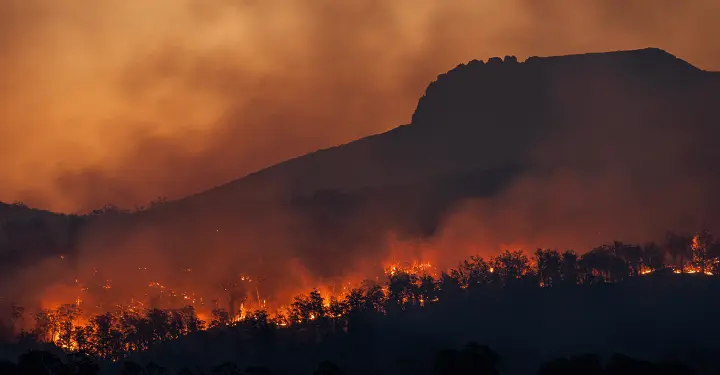
Carbon dioxide emissions, growing year after year, are making global temperatures rise, which results, among other things, in the global warming that has intensified in recent years. We hear more and more often about forest fires caused by droughts, which cover huge areas, destroy forests and threaten the lives not only of people but also of many species of animals and plants.
Water, which every organism needs to live, is exploited in huge quantities. Poorly regulated river “flows” are also a major problem. Too much fresh water flows into the sea instead of being stored to irrigate the river basins. Low water levels put more stress on plants, which become increasingly vulnerable to all kinds of parasites and fungi (e.g. mould, mistletoe and bark beetles).
- MOULD – the most common type of mould on trees is grey mould. It appears as a grey coating on the bark.
- MISTLETOE – a parasitic plant. It carries out photosynthesis itself, but takes the other substances it needs, such as water, from its host – the tree.
- BARK BEETLE – an insect that most often attacks already weakened trees, and in recent years even young and healthy ones. A bark beetle infestation can result in deforestation on a huge scale.

Under normal conditions plants deal with parasites themselves by flooding them with resin. Without enough water, trees cannot produce enough of it.
Wood is a basic natural raw material, and its importance is growing very fast. Diseased or infested trees lose up to several quality classes. This means that, for example, they are no longer suitable for structural beams. Another consequence of parasite-infested or diseased trees is lower timber value, which means lower income. Forest monitoring is used to solve all the problems described above.
What problems do drones solve in forestry?
Forest monitoring with drones means observing and analysing the condition of vegetation in forested areas. It helps determine the extent of damage caused by natural disasters or pests and supports forest management. Foresters have used satellite images to monitor forests for many years, but drones are becoming increasingly popular thanks to the better resolution they provide. The rapidly growing drone market delivers ever more interesting and reliable solutions that improve forest management. Drones and specialist software based on artificial intelligence quickly provide the right data, such as the location of fire sites, the size of burnt areas and the health of individual trees. This is a significant help in forest management.
Traditional tree inventory is time-consuming and based on statistical methods. Photogrammetry combined with ML software (machine learning) gives us reliable information, and collecting data for a given area is three times faster than with traditional methods. With modern technology, people only need to choose the method, set the right parameters and then check the results.
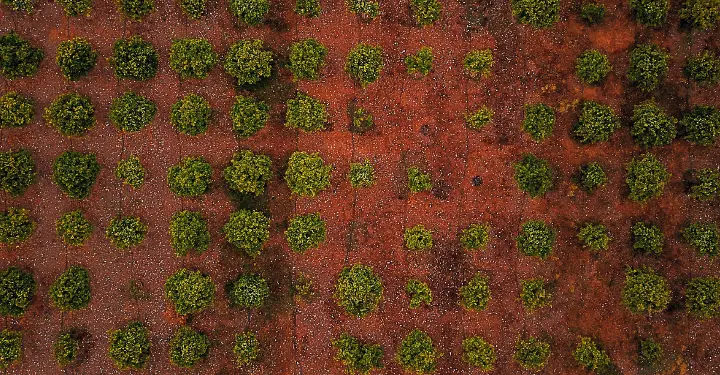
One of the most common tree parasites in the continental region is the already mentioned bark beetle. One of the most popular indices for fighting this pest is the Normalized Difference Vegetation Index (NDVI), which uses the near-infrared and red bands to determine plant health. This makes it easy to identify areas with diseased or dead trees.
To manage forests quickly and efficiently, BZB UAS has developed an algorithm for the automatic classification of forest areas, eforest.xyz, which supports foresters every day in tasks such as tree inventory. Purchased as a subscription, the software is available to the customer at any time, so they can upload their data, which the system then analyses automatically. The report shows, among other things, the number of trees in a given area and their parameters (diseased/dead/healthy).

What are the benefits of using drones in forestry?
The undeniable advantages of using drones for forest monitoring are savings in time, people and money, as well as protection of the natural environment and life on Earth.
By using drones combined with artificial intelligence , BZB UAS helps foresters act faster to protect forests through inventory, pest detection, assessment of tree health and calculation of areas affected by natural disasters. Drones make it possible to collect data from huge areas and from the hardest-to-reach places. The need for people is minimised, and costs fall as a result.
Forest monitoring with drones is essential for protecting the natural environment worldwide. In an era of climate change it is especially important to act quickly in order to minimise and prevent its effects. Click the link to find out more about our services for forestry – is becoming so important.
BZB UAS applications for foresters
To better illustrate the use of drones in forestry , here is an example of our cooperation with the Regional Directorate of State Forests in Zielona Góra, where data was collected with drone flights and a crewed aircraft carrying our own photogrammetric pod, in order to identify trees infested by bark beetles. Diseased trees were identified using the previously mentioned NDVI index and RGB images. The trees were divided into dead trees and trees in the early stage of dying. They were assigned to each category based on crown colour. Dead trees, whose needles turn rust-coloured, were easily detected by the NDVI index, which is sensitive to low chlorophyll levels. The study identified the locations of about 62,000 trees in an area of 430,000 ha that had potentially been infested by bark beetles. After the results were handed over, the indicated areas were examined in detail and the diseased trees removed. The Regional Directorate in Zielona Góra assessed the accuracy of the indications at about 85%.
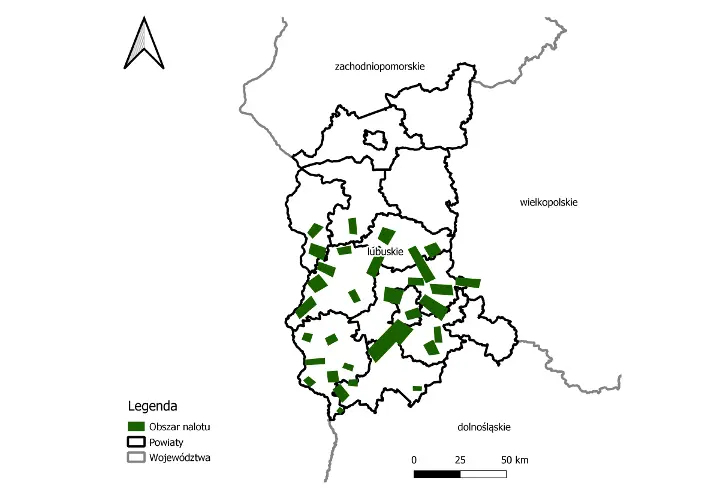
Advanced technologies are an attractive alternative to the methods traditionally used in forestry. Foresters' work is faster, because they can focus only on the areas indicated by the system. Data collection becomes possible even over large areas, with additional time savings. The method described allows pests to be detected quickly and a faster response.
Contact us and see how drones can work in forestry